
How to Negotiate Real Estate Price Effectively
Last Updated: October 23, 2026
Quick Summary
To negotiate real estate price effectively, start by researching comparable sales from the past 90 days in the same neighborhood, assess the home's condition and repair needs, then build an evidence-based opening offer 3-7% below market value with documented justification. Your opening number should leave room between it and your maximum budget so you can move through counteroffers without exceeding your ceiling.
- Compare the listing price to recent comps in the same neighborhood; a $450,000 listing with $420,000 comps shows clear negotiation room.
- Major repairs like a leaking roof or failing HVAC are legitimate deductions from the comp value and justify a lower offer.
- In a buyer's market, sellers commonly expect offers 5-15% below asking; in a seller's market, the gap narrows to 2-5%.
- Attach your comps analysis and repair estimates to your written offer to show your number is evidence-based, not arbitrary.
- After inspection, choose the right remedy for each issue: seller repair, closing credit, price reduction, or walk away based on the problem type.
Table of Contents
- Research Comparable Sales and Market Conditions
- Assess the Home's Condition and Needed Repairs
- Determine Your Maximum Budget and Opening Offer
- How Much Below Asking Price to Offer on a House
- Build Your Offer Package With Evidence and Terms
- How to Respond to a Counteroffer on a House
- Negotiating Repairs After a Home Inspection
- Seller Concessions in a Real Estate Transaction
- Frequently Asked Questions
Research Comparable Sales and Market Conditions
Start with same-neighborhood sales from the last 90 days with similar square footage, age, condition, and features to help you negotiate real estate price effectively.
Comps show what the market actually pays, not what sellers ask. A home listed at $450,000 with comps at $420,000 shows where negotiation room exists.
Check your local MLS, county records, and sales-history aggregators. Watch days on market: fast sales signal strong demand; lingering listings may signal overpricing.
At North Ga Homes Group at Waldrip Real Estate, we analyze local market data for every client, tracking seasonal trends, neighborhood patterns, and pricing shifts to inform your opening offer.
Assess the Home's Condition and Needed Repairs
Walk the property and photograph obvious issues: roof condition, foundation cracks, outdated HVAC, plumbing, and electrical concerns.
Major repairs are negotiation ammunition. A roof needing replacement in five years is one thing; an actively leaking roof is leverage.
Get a professional inspection if you're serious, the report justifies your offer price or repair requests before closing.
Don't exaggerate minor issues, but don't ignore real ones: $15,000 in needed repairs is a legitimate reason to adjust your offer downward.
Determine Your Maximum Budget and Opening Offer
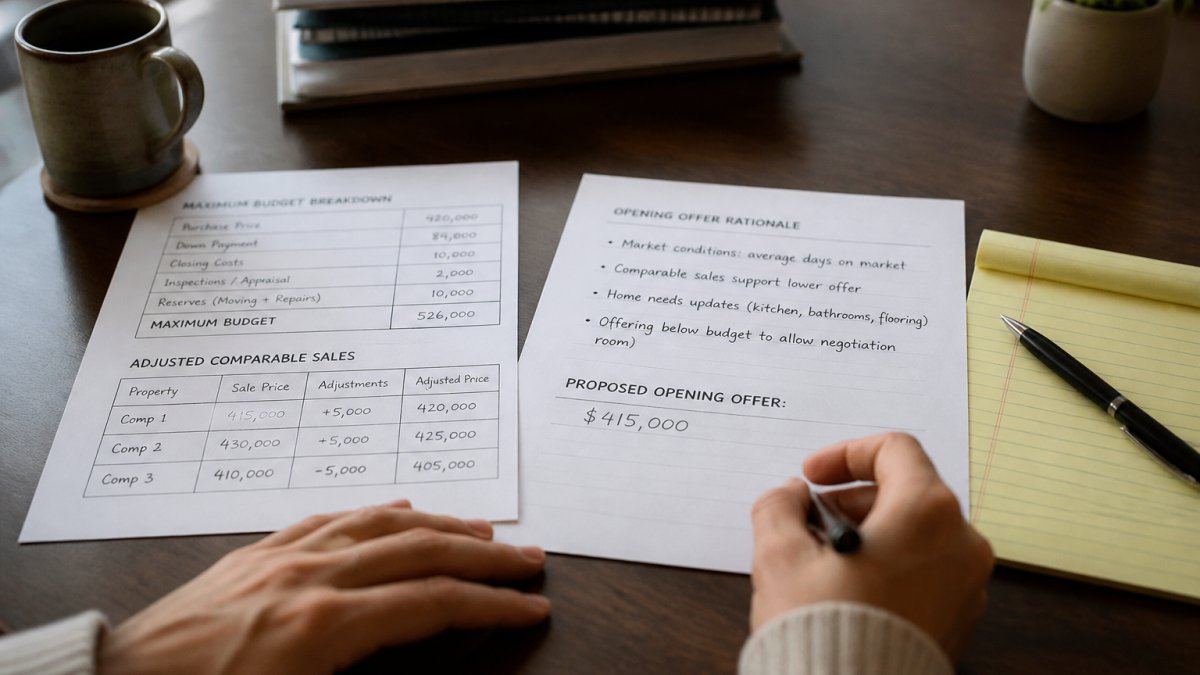
Your walk-away number and opening number are different figures; confusing them is the most common way buyers lose leverage. Set the ceiling first, then work backward to an opening offer with room to move.
Build your true maximum from the bottom up
Most buyers anchor on a monthly payment. A defensible maximum accounts for every dollar leaving your account before and after closing:
- Down payment, the amount you can document, not the amount you hope to save.
- Closing costs, commonly 2-5% of the purchase price for a financed purchase; on a $400,000 home that is roughly $8,000-$20,000. Ask your lender for a Loan Estimate for the real number.
- Reserves, a cushion for the unexpected. A common guideline is three to six months of mortgage payments in reserve after closing (Figure out how much you want to spend).
Write the ceiling down before you tour a single home. A number invented mid-negotiation is a reaction, not a ceiling.
Translate comps and condition into an opening number
To negotiate real estate price effectively, your opening offer should be traceable to evidence, not gut feeling:
- Start with the adjusted comp value. Take the three to five closest recent sales and adjust each for differences in square footage, lot size, condition, and upgrades. The result is your evidence-based value.
- Subtract known repair costs. If the inspection or your walkthrough reveals $15,000 in needed work, that is a legitimate deduction from the comp value, not a negotiating trick.
- Apply a market-condition adjustment. In a buyer's market, sellers commonly expect offers below asking; in a seller's market, the spread narrows sharply. Your agent can tell you the current list-to-sale ratio in your submarket.
- Set the opening offer below your ceiling but above your evidence floor. The gap between your opening offer and your ceiling is your negotiating room. If you open at your ceiling, you have none.
Experienced buyers often open roughly 3-7% below evidence-based value on an average-condition home, holding part of that gap in reserve for counteroffers. The percentage matters less than tying every move to a number you can defend.
Script: presenting the opening offer
How you frame the number matters as much as the number. A written rationale signals you're serious and gives the seller a non-emotional reason to say yes.
"We've reviewed the recent sales on [street] and [street] from the past 90 days, along with the inspection findings on the roof and HVAC.
Notice what the script doesn't do: it doesn't apologize for the number or reveal your ceiling.
Know when to hold and when to move
Your ceiling is not a suggestion. If the seller's counteroffer pushes past it, walk away or restructure the deal, don't stretch. Restructuring can mean seller concessions, an adjusted closing date, or reducing contingencies you can afford to reduce.
How Much Below Asking Price to Offer on a House
How far below asking you offer depends on several factors.
Condition influences your starting point: significant repairs justify a larger discount; excellent condition with recent updates may not.
Consider days on market: 120 days signals a motivated seller; three days suggests strong demand.
A practical approach: start 5-8% below asking on average-condition homes, then adjust for comps, condition, and market.
Build Your Offer Package With Evidence and Terms
Your offer isn't just a number, it's a package including price, down payment, financing type, contingencies, and proposed closing date.
Attach your comps analysis to support your price and show you've done your homework.
Consider offering a reasonable earnest money deposit. This shows you're serious. Typical deposits range from 1-3% of the purchase price.
Be clear about contingencies. Most buyers include inspection and financing contingencies; some sellers push back on inspection contingencies in competitive markets.
How to Respond to a Counteroffer on a House
When the seller counters your offer, you have three options: accept, reject, or counter back. Most negotiations involve multiple rounds of counteroffers.
Read the counteroffer carefully. The seller might adjust price, but also other terms, closing date, contingencies, or repair responsibilities.
If the counteroffer is close to your maximum budget, you might accept it.
Include a written explanation with your counteroffer. "We appreciate your counteroffer.
Watch for signals that the seller is done negotiating.
Negotiating Repairs After a Home Inspection
The inspection is where the negotiation actually begins for many buyers. The opening offer got you to a price; the inspection report tells you whether that price was right. This is also the stage most guides skip, so treat it as your chance to negotiate with better information than the seller had when they priced the home.
Sort findings into three buckets before you ask for anything
Not every line in an inspection report is a negotiating point. Before you send a request, sort the findings:
- Safety and structural issues, foundation movement, roof leaks, electrical hazards, gas leaks, sewer line problems. These are legitimate grounds for a credit, a repair, or a price reduction.
- Systems near end of life, an HVAC unit or water heater within a few years of replacement. These are negotiable, but expect pushback; sellers often argue the price already reflects them.
- Cosmetic and maintenance items, paint, caulk, minor landscaping, worn carpet. Raising these damages your credibility and invites the seller to dig in on the items that matter.
A useful discipline: if you would not walk away over it, do not lead with it.
Choose the right remedy for each issue
There are four remedies, and they are not interchangeable:
- Seller makes the repair before closing. Best for safety items and for repairs that must be permitted or warrantied. The risk is that the seller chooses the cheapest contractor. Ask for receipts and a transferable warranty.
- Seller credit at closing. Best when you want to control the work or when the lender allows the credit. Credits are capped by loan program rules, conventional loans commonly allow seller concessions in the 3-9% range depending on down payment, while FHA and VA loans have their own limits. Confirm the cap with your lender before you ask.
- Price reduction. Best for large, structural, or hard-to-quantify issues. A price reduction lowers your loan amount, your closing costs, and your monthly payment, a credit only helps at closing.
- Accept as-is and walk away from the issue. Sometimes the right answer when the price was already fair and the issue is minor.
Worked example: credit versus price reduction
Suppose the inspection reveals a roof that needs replacement, estimated at $12,000, on a home under contract at $400,000 with 20% down.
- A $12,000 closing credit reduces your cash needed at closing by $12,000, but your loan amount and monthly payment stay the same.
- A $12,000 price reduction lowers the purchase price to $388,000, which lowers your loan amount by $9,600 at 20% down and reduces your monthly payment for the life of the loan. It also lowers your closing costs slightly, since transfer taxes and some fees are based on price.
For a large, permanent defect, the price reduction is usually the stronger remedy. For a repair you want to manage yourself, the credit is usually better. The point is to choose deliberately rather than accept whichever the seller offers first.
Handle the appraisal gap before it becomes a problem
If your offer is financed, the appraisal can reopen the negotiation. If the home appraises below the contract price, you have three paths:
- Renegotiate the price down to the appraised value, using the appraisal as independent evidence.
- Cover the gap in cash, which only makes sense if you have the reserves and the home is worth it to you.
- Exercise your appraisal contingency and walk away, keeping your earnest money.
An appraisal gap clause, a promise to cover a set dollar amount above the appraised value, can strengthen an offer in a competitive situation, but it is a real financial commitment. Do not include one you cannot fund.
Script: presenting the repair request
"The inspection identified three items we consider material: the roof is at end of life, the electrical panel has a double-tapped breaker, and the HVAC is past its expected service life. We have estimates totaling $[amount] for these items. We're requesting a $[amount] credit at closing so we can complete the work after closing with contractors of our choosing. We're not asking for cosmetic items, and we're prepared to move forward promptly if we can agree on this."
Specific, documented, and limited to material items. That is the request a seller can say yes to.
Know when to walk
Walking away is a legitimate outcome, not a failure. If the inspection reveals a structural problem the seller will not address, or if the appraisal gap exceeds what you can fund, the disciplined move is to terminate under your contingency and keep your earnest money.
Seller Concessions in a Real Estate Transaction
Seller concessions go beyond price and repairs.
Common concessions include:
- Covering some of your closing costs
- Including appliances or fixtures in the sale
- Providing a warranty on major systems
Closing cost assistance is popular. Sellers often cover 2-5% of the purchase price in buyer closing costs.
Appliance inclusion matters more than many buyers realize.
Request concessions strategically. If you're offering a strong price, ask for fewer concessions.
Concessions are negotiable just like price. The seller might agree to some and reject others.
Working with an experienced real estate agent makes negotiation smoother.
Frequently Asked Questions
What is a reasonable amount to negotiate below asking price on a house?
The reasonable range depends on market conditions and property condition. In a buyer's market, 5-10% below asking price is common. In a seller's market, offering at or above asking is typical. Research comparable sales in your area, if the asking price exceeds fair market value based on comps, you have stronger negotiation leverage. Most sellers expect some negotiation; opening 3-7% below asking price signals serious interest without insulting the seller.
How do you respond to a seller's counteroffer on a house?
Review the counteroffer carefully and compare it to your maximum budget and the home's fair market value. If the price is still within your range, respond with a counter-counteroffer that splits the difference or moves closer to the seller's position while staying within your walk-away price. Include updated contingencies or earnest money if appropriate. Respond within the deadline given, delays signal you're losing interest. Keep your tone respectful and professional; the goal is to find common ground, not to 'win' against the seller.
What can I negotiate besides price in a real estate transaction?
Seller concessions extend beyond price and include repair credits, closing cost assistance, appliance inclusion, extended closing timelines, or pre-closing repairs. After inspection, you can negotiate who pays for specific repairs or request the seller to complete them before closing. Financing contingency terms, inspection contingency length, and earnest money amount are also negotiable. These alternatives are especially valuable in a seller's market where the asking price is firm but the seller may offer flexibility on terms.
How does a home inspection affect price negotiations?
Inspection findings give you concrete evidence to renegotiate price or request repair credits. If major issues emerge (roof, foundation, HVAC), use licensed inspector estimates to justify a price reduction. Request the seller repair items or credit you at closing. Present findings respectfully with documentation; emotional language weakens your position. If repair costs exceed your threshold, you can renegotiate the purchase price downward or walk away if you included an inspection contingency in your original offer.


